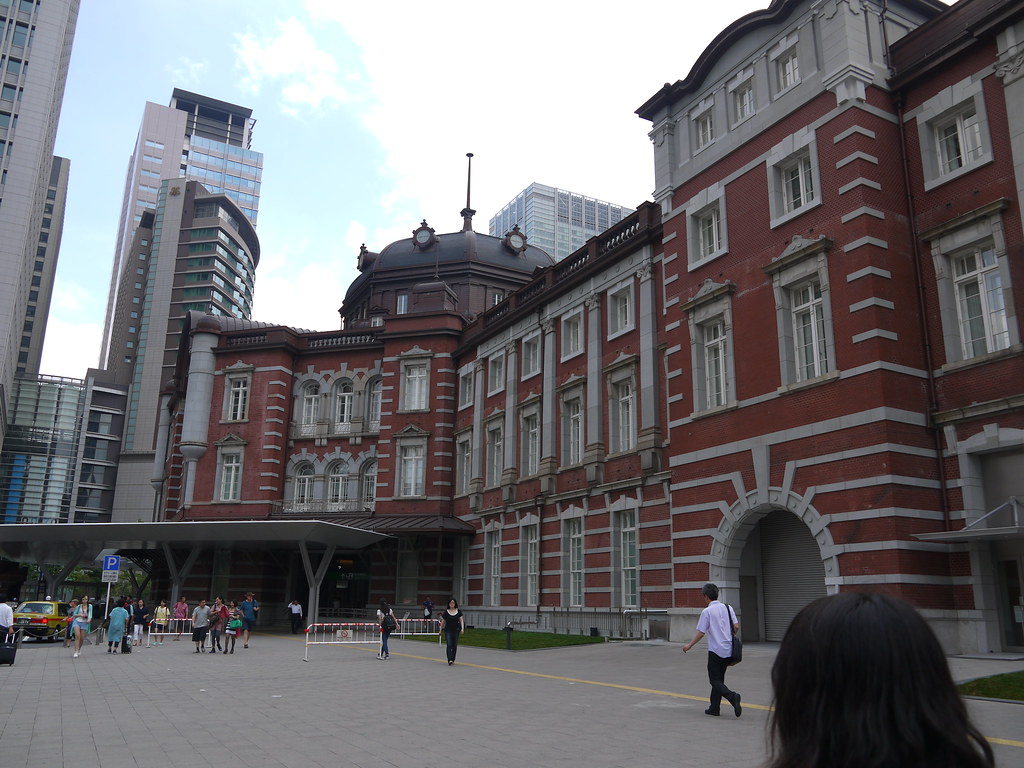

Tokyo Station (東京駅, Tōkyō-eki) is located in Marunouchi, Chiyoda Ward, Tokyo, and serves as a massive transportation hub that integrates multiple railway companies and transit lines. Operated jointly by JR East, JR Central, and Tokyo Metro, it encompasses the Shinkansen, conventional railway lines, and subway systems. It is one of Japan’s busiest and largest stations, serving as a central hub of the national railway network.
As the starting point of the Tokaido Shinkansen (including the connected Sanyo Shinkansen) and the Tohoku Shinkansen (including the Yamagata, Akita, Joetsu, Hokuriku, and connected Hokkaido Shinkansen), Tokyo Station provides access to major cities across Honshu, Shikoku, Kyushu, and Hokkaido. From Tokyo Station, passengers can reach 34 prefectures throughout Japan. With approximately 3,000 train departures daily, it is one of the busiest stations in the world, serving an average of about 1.15 million passengers per day, ranking seventh globally in passenger usage.
The station’s layout is vast, featuring 18 conventional railway tracks (10 above-ground tracks on 5 platforms, and 8 underground tracks on 4 platforms), 10 Shinkansen tracks (10 above-ground tracks on 5 platforms), and 2 underground tracks on 1 platform for the Tokyo Metro Marunouchi Line. Covering an area of about 46,800 square meters, it is among the Japanese stations with the highest number of platforms. Unlike many terminal-style central stations in Europe, Tokyo Station adopts a north–south through-station design, allowing most lines to operate through services.
The Marunouchi district, where Tokyo Station is located, is one of Japan’s largest business areas, neighboring Otemachi, Yurakucho, and Nihonbashi. Its underground passages directly connect to numerous office buildings and department stores, forming an extensive underground shopping and pedestrian network.
Additionally, the Marunouchi Station Building of Tokyo Station, completed in 1914 (Taisho 3) and designed by renowned architect Kingo Tatsuno, is a Western-style red-brick building with significant historical and architectural value. It was designated as an Important Cultural Property of Japan in 2003, making it one of only two station buildings in the country to receive this honor (the other being Mojikō Station in Fukuoka). After years of restoration and reconstruction, the Marunouchi Building remains one of Tokyo Station’s most iconic visual landmarks.